Wednesday, May 20, 2009

THE UGLY DUCKLING (PICTURE BOOK)

PICTURE BOOK
THE UGLY DUCKLING by Rachel Isadora (Putnam)
Original nursery tales are so charming, so eloquent, and often so freaking hard to read to the five-year-olds who would most like to hear them. Enter long-time picture book talent Rachel Isadora, who has done such a stunningly fine job on introducing a new generation of children to classic folkloric plot lines such as THE PRINCESS AND THE PEA, THE TWELVE DANCING PRINCESSES, RAPUNZEL, HANSEL AND GRETEL and THE FISHERMAN AND HIS WIFE, and even manages to give them a multicultural and more inclusive flavor by penning them against the African backdrop where she lived for ten years. The direct, unfettered writing style is more in keeping with an oral tradition that is perfect for story time, and is highlighted by gorgeous painted paper collage art. Silhouettes of a flock of wild geese against a smoldering sunset over a savanna! The drama of the little duck fading amidst the heavy blue icicles of winter! And the fresh depiction the ugly duckling's emergence into a swan is a picture that speaks a thousand words, or at least three: black is beautiful.

Though my favorite retelling of Hans Christian Andersen's "Ugly Duckling" is still Frank Loesser's version (very nice to make into a puppet show and play the recording if you are not a confident singer, by the way), Isadora's interpretation is a welcome one, a lovely addition to any fairy tale collection, and a necessary one in urban schools. (5 and up)

Also of interest:
Some more fair fowl, new from picture-book land.

THE MISSING CHICK by Valeri Gorbachev (Candlewick) The barnyard goes ballistic after a mother hen sends out an Amber Alert. Everyone in the book is so responsive, how can young listeners help but join in the search? Gorbachev's books are always dependable picks for story time, and his fabulously emotional, anthropomorphic characters are a throwback to the style of Richard Scarry. (4 and up)

HERE COMES GOSLING by Sandy Asher, illustrated by Keith Graves (Philomel)

"Love new babies!" Froggie cried. "When will they be here?"
"Soon," said Rabbit.
"How soon?" asked Froggie.
"One o'clock," said Rabbit.
"That's not soon!" cried Froggie. "That's LATER. MUCH LATER. Can't wait that long."


Yes, Froggie love babies. Froggie love lunch. Froggie love company. But Froggie no love waiting. And it turns out Froggie also no love the loud and terrible honking sound that the visiting gosling makes. As for the artwork, just look at that cover...yes, it's that hilarious all through. Buoyant, stylized illustrations with lines that stretch and then spring back into roundness verge on the rubbery, but the show is stolen by strong characterization, supported by an impeccable melding of picture and prose. A silly sing-along song that invites group participation recurs throughout. Capturing the sometimes manic swings as well as the sincerity of the preschool set, this is one little picture book that goes beyond the starchy "new baby" storyline and deserves a big noise. (4 and up)

TOUGH CHICKS by Cece Meng, illustrated by Melissa Suber (Clarion)

From the moment Mama Hen's eggs burst open, she knew she was dealing with some pretty tough chicks...
"Make them be good!" clucked the hens in the henhouse.
Mama Hen ruffled her feathers. "They are good!" she replied.

Yes they are. So what if they wanted to look under the hood of the tractor? They wanted to see how it worked, after all. So what it they swing off the cow's tail and go flying through the air? ("Good form," Mama Hen can't help but notice.) So what if they enjoy a good roll in the pigpen; who doesn't? Peep, peep, zoom, zip, cheep, these are some energetic little eggheads, but when the slop hits the fan, the farm is rescued from disaster thanks to the insights gained by the very behavior everyone in the barnyard has been complaining about. Feminist backlash, take that! This book celebrates learning by doing and being true to yourself, whether or not it seems different or overly assertive to others. Don't be chicken, read it! (4 and up)

DUCK! RABBIT! by Amy Krouse Rosenthal, illustrated by Tom Lichtenheld (Chronicle) Told in two debating voices, this book is a ticklish play on a classic optical illusion. What you see depends on how you look at it, but one thing all readers can agree upon: there's more than one way to look at the world, and for that we're all lucky ducks (or is it rabbit's feet?). (5 and up)

And may I take this opportunity to remind you of the classic PETUNIA by Roger Duvoisin (Knopf), the silly goose with a smarty-pants streak who thinks carrying a book makes you wise, only to learn the hard way that you have to crack it open once in a while to really reap the rewards? This title is as necessary to the children's picture book canon as War and Peace to the adult booklist, though, as Petunia would be the first to notice, it's a little lighter to carry around. (5 and up)

Some of my finest feathered friends are the bloggers at Three Silly Chicks, cocks-of-the-walk when it comes to reviewing funny books (an interview with Erica Perl, author of CHICKEN BUTT, currently featured), and just for fun, check out this video about a real life Make Way for Ducklings. I'll try to embed it, but in case it goofs, watch the charming story at http://www.youtube.com/watch?v=prRmQ-OldyE.

WATCH: Parade Leads Ducklings to Safety newsClicker.com, live headlines from around the world. News for your website. TV Shows to watch, the good shows too.

Mon, 18 May 2009 21:05:09 -0400

Links are provided for informational use. Don't forget to support your local bookseller.
More Esmé stuff at www.planetesme.com.

Tuesday, May 19, 2009

THE BOOK WHISPERER (RESOURCE)

I don't usually stray from reviews and recommendations of books for kids, but in the interest of children's literacy I need to shout out about a title that might do for independent reading what Jim Trelease's READ-ALOUD HANDBOOK did for read-aloud.

RESOURCE
THE BOOK WHISPERER: AWAKENING THE INNER READER IN EVERY CHILD by Donalyn Miller (Jossey-Bass)

Why should I subject students to negative experiences now in order to prepare them for negative experiences later? I just don't think mindless work is what I should be grooming them for. I grow weary of hearing teachers say, 'We have to get them ready for seventh grade, or high school, or college.' They are in sixth grade! What about having an enriching powerful, glorious year in sixth grade? The purpose of school should not be to prepare students for more school. We should be seeking to have fully engaged students now.

Sporting possibly the best book title since Smith and Wilhelm's READING DON'T FIX NO CHEVYS, the moniker unfortunately does not clue us in to the real topic that this book addresses. This book is less about awakening the child than awakening the educator to the true dangers of "The Matthew effect" (referring to Matthew 13:12, "the rich get richer and the poor get poorer") in which "students who do not read regularly become weaker readers with each subsequent year," while "their peers who read become stronger readers...creating an ever-widening achievement gap." The upshot of all this indicates that "no matter the intervention, developing readers must spend substantial instructional time actually reading if they are to attain reading competence." This is a book about making time to read.

Miller invites educators to consider what reading means to them, asking where they fall in "Rosenblatt's transactional theory," defining two types of booklovers: efferent readers, who see reading as a way to acquire knowledge, and aesthetic readers, who see reading as an emotional and intellectual journey. She then challenges educators to consider how the kinds of readers we are impacts the way we deliver instruction. Miller also does the important work of redefining children as readers. She offers us a new and positive vernacular: "developing" readers instead of "struggling" readers, "dormant" readers instead of "reluctant" readers ( she quotes Mark Twain: "The man who does not read great books is no better than the man who can't"), and a new category, the "underground" reader:

Underground readers are gifted readers, but they see the reading that they are asked to do at school as completely disconnected than the reading they prefer to do on their own. Underground readers just want to read and for the teacher to get out of the way and let them.

Make sure to have a pile of post-it notes handy when approaching this book, because you will want to mark and remember all the fresh ideas, succinct research, the helpful sidelines (including Daniel Pennac's "Rights of the Reader" and Jen Robinson's "Why You Should Read Children's Books as an Adult"), booklists, websites, and student forms and samples. She outlines conditions for learning, and brings the responsibility of the child into the equation. For all of these selling points, the great, great strength of this volume is that it does not only identify problems in the way we approach instruction, it offers viable remedies. Miller does an extraordinary, comprehensive, and long-overdue-in-the-profession job of naming practices that are habitual but don't work, and then offers alternatives. Traditional practices like teaching whole-class novels, round-robin reading (shudder), comprehension tests, reading logs, book reports and extrinsic incentives all get modern makeovers via genre studies, book commercials, book reviews, audiotapes, reading buddies and role models. This book is so smart in that it reminds us that pedagogy is a science, a series of experiments, some of which fail but some which succeed, and like a scientist she offers both her own anecdotal evidence and observations for other scientists to compare.

Admittedly, there are some points that I myself have experienced differently in my own lab. I am loath to completely give up the whole-class novel, which I have found increases exposure to print and builds community when paired with read-aloud in a whole-group setting. In practice, I probably would push children to read further through books they may not initially like (out of respect and gratitude for my fifth grade teacher Mrs. Schultz, who insisted I go deep into Farley Mowat's OWLS IN THE FAMILY even though I was hardly in the mood for a story of boys in Saskatchewan, and my eighth grade teacher Mrs. Smith's plodding through Nathaniel Hawthorne's initially inscrutable HOUSE OF THE SEVEN GABLES, only to break through around page 48 with what was akin to a sunrise of beautiful writing). Miller is somewhat laissez-faire for my taste when it comes to the care and keeping of books, bemoaning "Those plastic bags [protecting books] are a symbol that reading is an act students cannot take responsibility for without monitoring from a teacher. Why do we work so hard to build fences between our students and books?" As a teacher who has spent so much out-of-pocket to build a collection and who covers paperbacks with contact paper, book care seems like an etiquette issue as much as a responsibility issue, and I would never dream of borrowing a friend's book without securing it safely in a waterproof bag.

Opinions and nitpicking aside, the fact remains: Miller is a real teacher with real rapport, not a robot delivering prescribed curriculum. She writes quite honestly about her own trials and errors, and what works for her, giving a convincing argument as to why they will work for us, too. She has been a renowned and helpful blogger, and a seasoned sixth grade teacher in Texas. In the course of my own travels and exchanges, I have come to the conclusion that Texas boasts a uniquely impressive breed of teachers and school librarians. The state is home to a truly extraordinary Association of Future Educators, offering support (and unbridled enthusiasm) at an early age for those who receive "the calling," and a teaching corps who often receive the brunt of some particularly brutal standardized testing stress. As a result, many have become notably ingenious about delivering exciting and progressive education in the face of adversity. This credibility inspires a willingness to at least try what Miller is advocating or consider old practices with new eyes, and whether or not you agree with every point, you can trust each one is derived from a place of thought, experience and professionalism, worthy of both reflection and conversation.

We are very much on the same page when it comes to validating reading choices by children, and in fact, there have been many people on that page...the page itself is not new. In an article I wrote for Educational Leadership magazine (May 2000) "The Best Twenty-Five Cents I Ever Spent," I allude to Jeanette Veatch's slim but genius 1968 title, HOW TO TEACH READING WITH CHILDREN'S BOOKS.


Veatch is very simple and direct. "First, get LOTS of BOOKS! BIG books, little books, FAT books, thin books, fairy stories, cowboy stories, mysteries, silly stories..." About thirty years later, this is all reiterated and advocated in another way in my own book, HOW TO GET YOUR CHILD TO LOVE READING, in the context of what I refer to as a "motivation-based approach to reading." Best practice still boils down BIG books, little books, FAT books, thin books. But what Miller does here that's new is to fit the argument for more time spent reading these books with some brass knuckles, just the arsenal needed by teachers to battle the bullying aftershocks of No Child Left Behind. Miller offers a very specific plan, a "forty book requirement" (broken down by genre) that gets kids reading more whether or not they read all forty. However teachers tweak it to reflect style, at the heart of this book is a way that works and a way that resonates with real children. If you read between the lines, this book says "you want results? I'll give you results. Just give me the freedom to teach the best way I know how." Let's hope that's one book whisper that grows louder and louder and louder.

At the close of the last page, anyone who cares about children and reading will have a new appreciation of the importance of giving children the chance to read, the choice of what to read, and resources and strategies to make it all happen in the real world and in real time.

We can spend hours determining what students should know and be able to do, crafting instruction to accomplish the desired results, but without considering students' rights to an engaging, trustworthy, risk-free place in which to learn, what we teach will always fall short. Students must believe that they can read and that reading is worth learning how to do well. We have to build a community that embraces every student and provides acceptance and encouragement no matter where students are on the reading curve.

Oh, Donalyn Miller. You go, girl.

Also of interest:
More resources from more experts!
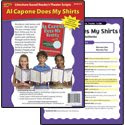
So, okay, its mid-May and the kids are starting to smell summer and getting antsy, but there's still a month to go, so how to keep reading fun and at the forefront? OOoooooOOOO, I just got these amazing reader's theater script sets sent to me by Toni Buzzeo, children's book author, librarian and proponent of this snazzy approach (and fresh alternative to "round-robin" reading). Each child is given a part as if in a play, and receives a snazzy laminated card with the lines to be read highlighted. Easy and fun, and a great subliminal way to get kids interested in reading the whole megillah! The series includes scenes from novels like Al Capone Does My Shirts by Jennifer Choldenko, Andrew Clement's Frindle, and Sahara Special by yours truly, as well as beloved picture books like Chicken Sunday by Patricia Polacco, Miss Rumphius by Barbara Cooney and Cynthia Rylant's Henry and Mudge series. For those who prefer the good ol' copy machine and highlighter pen, you can get ten, count-'em-ten reader's theater scripts in each book in the Read! Perform! Learn! series, which also includes "meet the author" interviews, interdisciplinary activity suggestions, worksheets, and standards, basically everything you'd need for a lesson plan. A boon to teachers and homeschoolers, this is also big fun for book clubs, playdates and family gatherings.

Once the Reader's Theater bug bites, you'll also want to check out Judy Freeman's outstanding resource ONCE UPON A TIME: USING STORYTELLING, CREATIVE DRAMA AND READER'S THEATER WITH CHILDREN IN GRADES PRE-K-6 which includes performance hints, songs, scripts, and the kind of fantastic annotated thematic booklists and bibliographies that made the author famous.

And as you compose summer reading lists, you will want to check out RAISING BOOKWORMS by Emma Walton Hamilton (Beech Tree), containing excellent techniques, activities and reading recommendations arranged in age groupings (babies and toddlers, preschoolers, elementary school and middle school), with a special section addressing FAQ's such as "Is It Too Late to Help High Schoolers?", "How Do I Know If My Child Has a Reading Problem?" "How Can I Best Use [The Internet and TV] To My Advantage?" and a super amazing appendix of tables outlining strategies for each age group. This is like having all the great little brochures and booklists you've been saving from the public library in one handy-dandy compendium, but written with all the warmth of a mom sitting across a kitchen table from you while your children are busy on a playdate.

Hope these guides give everyone a head start on circumventing the nefarious summer slide. Happy reading!

Links are provided for informational use. Don't forget to support your local bookseller.
More Esmé stuff at www.planetesme.com.

Sunday, May 10, 2009

NATALIE AND NAUGHTILY (PICTURE BOOK)

In honor of Mother's Day, how about an afternoon of shopping (or at least reading about it)?
PICTURE BOOK
NATALIE AND NAUGHTILY by Vincent X. Kirsch (Bloomsbury) Perhaps the only scenario that could top Eloise's dolce vita in the Plaza Hotel would be to have a house on top of the greatest department store in the world.
At bedtime, Natalie knew just what kind of story she wanted to hear: "There must be at least one happy ending at two cash registers." But it was never what Naughtily wanted to hear: "There must be two happy endings and one escalator!" When asked what they wanted for their birthdays, Natalie said: "To play on every floor of the store from top to bottom!" and Naughtily? "From bottom to top!"
The twin sisters have very distinctive styles, underscored by Natalie's Montessori-like order and offset by Naughtily's dragon and clown-suit haute couture. One rainy day, the girls insist upon being "helpful," issuing home-made maps and lists to insure that guests enjoy the full Nopps Department Store experience while giving a readers a floor-by-floor tour of the amazing place, from a fitting by the world famous designer Dandileoni to a demonstration of the new-and-improved automatic-flying-rainbow-making-umbrella on the gizmo and gadgets floor, to the toy department of our dreams,featuring a loopy rocket-ship rollercoaster, and even mile-long lines for returns, lost and found, complaints and directions, as any good department store should have. Thin-lined, extraordinarily detailed and wildly creative spreads invite children to indulge their visuals ids (and join in riding the unicorn on the antiques floor where a sign reads "do not ever touch anything"). A palette of fuschia, chartreuse, turquoise and gold screams wham, glam, thank-you-ma'am. This book is like getting to go in an elevator and press all the buttons, and then each time to have the double-doors open to miracles of imagination to boot (snow boots, fourth floor, by the way). I haven't seen the like of this book since the imaginative abandon of MAX AND SALLY AND THE PHENOMENAL PHONE by Milos Macourek and Adolf Born in the late eighties, or eye-popping childhood visits with my late grandmother to Marshall Field's Department Store in its full, glittering grandeur (sorry, Macy's, this is Chicago and it will always be Marshall Field's to me). Dozens of readings will still reveal new treasures tucked away to be found in these pages, though on the last endpaper Natalie Nopps has neatly provided a list of her own favorites to go back and seek. Like any great saleswoman, she knows just how to get us to be a return customer. Wow, I guess it's true: Nopps is topps, and so is this utterly fantastic title. (5 and up)

Also of interest:
More big business!
THE GOLLYWHOPPER GAMES by Jody Feldman, illustrated by Victoria Jamieson (HarperCollins) A father is falsely accused of embezzling money from the Gollywhopper Toy Company, but his son can save face for his family name by winning the manufacturer's incredible contest full of trivia and puzzles. A knockoff hybrid of Roald Dahl’s CHARLIE AND THE CHOCOLATE FACTORY and the challenging noggin scratching puzzle-solving style of Blue Balliet’s CHASING VERMEER (but slightly easier for middle-grade readers), this book is more than a gimmick, underscoring teamwork and with characters that are not plain just good or bad. Recommended to me first by kids (always a good sign). (10 and up)

On a personal note:
It may be of interest to check out the excellent History of Mother's Day, started in the incarnation as we know it by Julia Ward Howe, who made an impassioned "appeal to womanhood" to rise against war in rememberance of the pain suffered by bereaved mothers after the Civil War. It was further developed down the timeline by Appalachian Anna Jarvis, who sought to honor mothers past and present and came to dislike the commercial aspects of the holiday.

My Mother's Day gift to you is this link to Mom's version of The William Tell Overture (which I will try to upload, but in case it doesn't work, the link is at http://www.youtube.com/watch?v=5z4ZsA6X9fA.


Special thanks to my son for making me a mom, and to my goddaughter and family for helping me get my girlie-girl on at her tea party at the PlanetEsme Bookroom last Sunday. Strawberries and cucumber sandwiches for all! Thanks also to all teachers who act as moms-away-from home, loving aunties, grandmas, friends, and good ol' Mother Nature. Lots of great women out there to celebrate!


Links are provided for informational use. Don't forget to support your local bookseller.
More Esmé stuff at www.planetesme.com.

Thursday, April 30, 2009

TOTALLY IRRESPONSIBLE SCIENCE (NONFICTION)

NONFICTION
THE BOOK OF TOTALLY IRRESPONSIBLE SCIENCE by Sean Connolly (Workman)
Perform first aid on a carrot. See the real iron in a bowl of cereal. Step up your slime by giving it an electrical charge. Make a hovercraft out of an old CD. Stand inside a soap bubble. Hold a Viking funeral. Put a marshmallow on steroids. Cook up a batch of homemade lightning, or make a hot-air balloon out of a teabag, or build your own bottomless pit. Totally science? Oh, yes. Irresponsible? Maybe not, thanks to clear directions and helpful "Take Care" hints noted at the bottom of every experiment, as well as helpful "time factors" to consider (between two minutes to more than a day) and "scientific excuses," also known as explanation. Most of the experiments would probably be better served with a little help from an eagle-eyed adult (I don't think I'd let a kid cook the bacon for a Bacon Smokescreen), but this should be no problemo for a classroom teacher trying to engage a roomful of future scientists. It includes my all-time favorite experiment, "Egg in a Bottle," but generally goes waaAAAaaay beyond the "static balloon" and "floating pin on water" grade-school standbys (even the "Backyard Vesuvius" takes the exploding volcano to a new level). These wacked-out experiments put the mad in science and put to rest the "b" word, "bored." Wouldn't it be nice to never hear that one again? (9 and up, with adult supervision)

Also of interest:

EXPLORATOPIA by The Exploratorium (Little, Brown) Perhaps some of you have been fortunate enough to visit the Exploratorium in San Francisco, the "museum of science, art and human perception," and a mecca of learning and understanding. It's hard to visit that space with all of its hands-on fun and clear explanations and not want to bring it into every classroom in the country. This book can help you try! Just like the museum, you come away with the "why" as much as the "wow." Rich with background information, eye-popping photos are accentuated with colorful drawings to clarify steps and concepts even more fully. Worthy of a whole curriculum and a boon to homeschoolers, this is also a great book for shared science exploration as a family (hey, maybe replace "board game night" once in a while). (9 and up)

BLOOD AND GOO AND BOOGERS TOO! by Steve Alton, Nick Sharratt and Jo Moore (Dial) Subtitled "A heart-pounding pop-up guide to the circulatory and respiratory systems," this book gets off on the gross-out from the outset with some plastic lipid nasal discharge on the cover, and keeps readers gently gagging throughout with the photographic "guess the gross close up" feature throughout (cilia, damaged lung tissue, weakened bacterium). Booger gwee notwithstanding, the exposition on the human body has a steady flow, using appropriate scientific vocabulary without being overwhelming for the intended audience, and the illustrations throughout are brightly colored, cheerful and funny. When I showed a second grade teacher this book, I guess she was used to nasal discharge because she wasn't the least bit thrown. Instead, she used her respiratory system to breathe deeply and sigh, "Wow, this would have been perfect for teaching my unit on the human body." Once you find this has made your science-lover's heart beat faster, you can continue to satifsy their appetite for learning with CHEWY, GOOEY, RUMBLE, PLOP, the companion guide to the digestive system. (7 and up)

Speaking of science over-the-top, I'm hoping everyone is familiar with the Frannie K. Stein series. Sugar and spice and all things nice she's not, but Bunsen burners are a-popping to celebrate the arrival of this nonconformist who may well provide the female counterpart to Dav Pilkey's CAPTAIN UNDERPANTS. While Franny's mother might have hoped for one of the Ashley twins, she's got more of a Wednesday Addams on her hands, re-doing her bedroom's frou-frou decor to resemble a laboratory. As we meet her in the first installment, LUNCH WALKS AMONG US, Franny likes science a lot, but she likes making friends even more, and is troubled by the reticence of her peers to gather 'round. When her concerned teacher suggests Franny think of making friends as an experiment, she's talking Franny's language. After collecting the necessary data, Franny undergoes a dramatic transformation (brought to life courtesy of some mix-and-match pages in the book that will make your children laugh out loud), and finds the popularity she's been craving. But when her teacher is abducted by The Giant Monsterous Fiend, she makes a difficult decision and returns to her more craven self in order to create the lunch meat monster that can perform the rescue. While Benton may be accused of a certain amount of copy-catting and potty humor, there is definitely a method to the madness. The story has real conflict that both boys and girls will recognize, low-level vocabulary and page-turning suspense to ensure success for reluctant or emergent readers, and the cartoon illustrations are cool enough to compete with Saturday morning television. I hypothesize that this little girl who uses a snake to skip rope, builds a Barbie clone that can chomp the heads off of other dolls and has a green thumb for Venus flytraps has the potential to ooze her way into the hearts of many. (7 and up)

Links are provided for informational use. Don't forget to support your local bookseller.
More Esmé stuff at www.planetesme.com.

Wednesday, April 29, 2009

MOON RABBIT (PICTURE BOOK)

PICTURE BOOK
MOON RABBIT by Natalie Russell (Viking)
In this simply told, kinder-gentler version of "city mouse/country mouse," an urbane rabbit discovers a kindred spirit in the park and enjoys a stretch of days spent frolicking before her old lifestyle calls her back.

Back to her home, back to her favorite cafe, back to all the things she liked to see and do.
And she no longer gazed at the moon and wondered if there was someone out there.
Another little rabbit just like her.
Because she knew that there was.
And he was coming to visit the very next day.

The sweetness of the illustrations is a standout, from the attractive patchwork and silver foil moon on the cover, the muted, decorative tones and patterns, the ivy and blossoms and uniquely collaged foliage of the trees that blossom and twine from page to page, and most of all the loose and playful lines, the likes of which have not been seen since Robert Kraus's early work (namely, the RABBIT AND SKUNK series). The storyline is the antithesis of Shel Silverstein's controversial classic allegory THE GIVING TREE, in which a tree (or a woman?) gives and gives and gives until she ends up becoming a stump of her former self. Conversely, in this book, the decision to stay true to oneself and stay whole creates lives that are joyfully shared and ultimately broadened. No martyred bunnies here! It's funny how a book that is reminiscent of other great books can be so truly original. Happens once in a rabbit moon. (4 and up)

Also of interest:
Other darling new picture books in which less is more.

THE SECRET CIRCUS by Johanna Wright (Roaring Brook)
As a frustrated agent in my fantasy life, I am perpetually trolling etsy and the Renegade Craft Fair in search of future illustrators, and a couple of years ago I fell instantly in love with this artist and bought a lovely little print called "Ghost of Grandma" which hangs in my kitchen. She had gorgeous paintings featuring fortune tellers and treehouses and hot-air balloons so I asked her, "have you ever thought of doing children's book illustration?" and she said, " Funny you should say that! I have one, but I haven't found a publisher yet." So I waited and waited and waited and waited and at last we have the first foray from this delightful talent, which reads like looking through a kaleidoscope into an artist's dream. Shhhh, the young reader is privy to a secret show that only the mice know about, only the mice know what to wear, what to eat, how to get there and who they'll see, and most importantly, how to keep it all a secret. By the end of the book, one feels inducted into an exclusive, miniature club. A sketchy style in predominantly darker, autumnal tones is backlit by the sparkling of the recurrently appearing Tour Eiffel. A moody bedtime story that is tres bon. (3 and up)

PUZZLEHEAD by James Yang (Atheneum) Dedicated to "the genius who invented recess," oooh boy, what a charmer we've got here. Puzzlehead and his four friends go exploring for things to do, each finding a spot to fit in perfectly. When at long last Puzzlehead finds a place where all his angles fit, he still longs for his friends. Is there a way they all can play? A clever preschool surprise ending awaits to close this toy story in a satisfying way. Clean, angular and cheerful contemporary artwork, sponge-painted in spots against a white backdrop makes the best use of blocks in a book since Pat Hutchins' dramatic wordless adventure CHANGES, CHANGES. (3 and up)

On a personal note:
Chicago friends, are you-all going to the Celebration of Children's Books at 6:00 tonight at The Book Cellar, 4736 N. Lincoln? The invite reads: "Calling all teachers and parents! Join us for a very special evening celebrating children's authors. Discover new books, mingle with other parents and teachers, and receive special discounts on merchandise all evening!" There will be featuring an embarrassment of riches when it comes to authors and illustrators in attendance: Brenda Ferber, Adam Selzer, Ruth Spiro, Juanita Liepelt, Sean Callahan, Mary Jo Reinhart, Paula Nathan, James Kennedy, Renanah Lehner and Gina Bazer! WOW! You know you need your copy of HOW TO GET SUSPENDED AND INFUENCE PEOPLE autographed, don't you? Be there or be square (I in fact may be forced into being square tonight, but I'll try).

If they don't shut down the airlines because of swine flu, I'm looking forward to seeing old friends and people I admire at the New York Library Association conference this week, including (but not limited to!) Kyra Teis, illustrator of THE MAGIC FLUTE: AN OPERA BY MOZART, Nick Glass of TeachingBooks.net (if your school doesn't have this resource, you need it!), Martha Hamilton and Mitch Weiss, who wrote my favorite storytelling guide of all time, and Starr LaTronica and Sue Bartle, two of the most inspiring and gifted librarians I have ever met in my adult life. I'm also looking forward to meeting Bill Barnes and Gene Ambaum, creators of the celebrated booklover's comic strip, Unshelved...yes, I'm lucky, and with any luck, I'll see you there, too!

Last but not least, kudos to friends at TeachingAuthors on their new blog, sure to be a boon for those aspiring to be published or who seek to hone their craft, and to Jen Robinson, a true children's book expert and one of the hardest working women in the kidlitosphere, for lending her blogging expertise to Booklights, the parenting component on-line at PBS. Great efforts, women, and much appreciated!
Links are provided for informational use. Don't forget to support your local bookseller.
More Esmé stuff at www.planetesme.com.

Sunday, April 26, 2009

A WHIFF OF PINE, A HINT OF SKUNK (POETRY)

POETRY
A WHIFF OF PINE, A HINT OF SKUNK, A FOREST OF POEMS by Deborah Ruddell, illustrated by Joan Rankin (McElderberry)

She snoozed away the winter
in the darkness, all alone.
There's grumbling in her stomach
and she's chilly to the bone.

Her fur is flat and crusty.
Her swollen eyelids sting.
She's starving for a salad
and a heaping plate of spring.

Perhaps you are like the waking woodchuck described above, ready for your heaping plate of spring, and this book delivers it via a walk in the woods just in time for National Poetry Month. Charming line drawings (look at that fretful froggie, the proud beaver gloating atop a finished dam, the robin so rounded with the joy of singing, you can nearly hear it on the page!) and fantastic poems give voice to a toad, tiger beetle, raccoon, chipmunks, a night owl, and even a wild turkey:

I find it most insulting/ that you traced around your hand
And colored all my feathers/ either plain old brown or tan...
Finally, I’m baffled/ that you’ve made me look so dumb.
My head is quite distinguished/ and it’s nothing like you’re thumb.

What sets this book apart is that it is natural, not only in terms of its content but also in its style. Each page emanates a kind of understated but undeniable talent; never precocious or cloying, there is something so genuinely fun here, it verges on the rare and is sure to be a revisited favorite in any poetry collection. Charming line drawings and poems play on all the senses, including the sense of humor. (6 and up)

Also of interest:
A FOOT IN THE MOUTH: POEMS TO SPEAK, SING AND SHOUT by Paul Janesczko, illustrated by Chris Raschka (Candlewick) All right. Admittedly, I have said that this author/illustrator team's invaluable guide to poetic forms, A KICK IN THE HEAD, belongs on every teacher's bookshelf. And yes, yes, I remember, I loved A POKE IN THE EYE: A COLLECTION OF CONCRETE POEMS in which readers can literally see poems take shape. But when this third volume landed on my desk, I thought these guys were pushing it. Another poetry anthology, great, we need that like, well, a poke in the eye or a kick in the head or a foot in the mouth! But no! This is different! These selections are really, really fresh, right out of the gate starting with contemporary author Tracie Vaughn Zimmer’s “The Poems I Like Best”:

The poems I like best/ wear classic black with vintage accessories/
And smell like a new book,/the spine just cracked.
The chitchat overheard on a city bus/or nonsense
volleyed between toddlers/on swings at the park.
My favorite poems/squeeze your hand/on a crowded street and say:
Look...

Other goodies like Edwin Morgan’s “The Loch Ness Monster’s Song” told entirely in onomatopoetic language gives Jabberwocky a run for its money, Bobbi Katz's "Pasta Parade" celebrates the language in the macaroni aisle of the grocery store, and Janet Wong offers a poem for two voices, one being Korean. There’s a ping-pong poem by Douglas Florian, a poem called “Good Hot dogs in both Spanish and English" by Sandra Cisneros, a haunted poem called “Where Lizzie Lived,” and it all ends on the high note of Walt Whitman’s “I Hear America Singing.” If poems are a kind of song for the spirit, this contemporary collection will definitely help you and the children hit the high note. I put my foot in my mouth; when it comes to poetry anthologies, this team is three for three. (8 and up)

MY UNCLE EMILY by Jane Yolen, illustrated by Nancy Carpenter (Philomel) In the interest of reminding children that there are real people behind the books they read, we have a very personal portrait of poet Emily Dickinson, affectionately referred to as "uncle" by her nephew, with whom she has a special bond through nature and lots of inside jokes. When Emily sends him to school with a poem and a bumblebee for his teacher, the poet's idiosyncrasies lead to teasing and trouble, but if one of Uncle's poems got him into it, another can lead him out. This period piece from the nephew's point of view really puts Emily first as a member of the family, and is decorated with Carpenter's inimitably graceful and sensitive artwork with a touch of etching style as befitting of the era. A very lovely companion read to the great introductory collection POETRY FOR YOUNG PEOPLE: EMILY DICKINSON and a classroom exploration. "Uncle" Emily is a great poet for children to know, and one to which they viscerally respond; after all, what preteen hasn't at some time felt, "I'm nobody, who are you?" (8 and up)

More resources! Don't forget to celebrate Poem in Your Pocket Day on April 30th, perfect to pair with Bobbi Katz's POCKET POEMS and the conveniently just released and equally cheerful companion collection, MORE POCKET POEMS. The Kidlitosphere keeps verse a special on the reading menu all year long thanks to Poetry Fridays. Sadly, genius librarian Caroline Feller Bauer's resource THE POETRY BREAK: AN ANNOTATED ANTHOLOGY WITH IDEAS FOR INTRODUCING CHILDREN TO POETRY seems to be out of print, but it's worth getting used or borrowing from the library. Also, be sure to check out PlanetEsme's Poetry Power page for hints on presenting poems (and a recipe for Haiku Fortune Cookies with matching bibliography)...mmmm, almost time for another open mike at the Bookroom, I suppose!

On a personal note
Kudos to Ms. Makagon's hipster first grade class, who on an impromptu visit was all decked out in black berets and reciting cooool poetry to finger-snapping applause! It reminded me of one of my favorite books in the world growing up, Suzuki Beane by Sandra Scoppetone, about the little beatnik girl who lived in Greenwich Village and dug poetry. You cats really know how to live!

Links are provided for informational use. Don't forget to support your local bookseller.
More Esmé stuff at www.planetesme.com.

Sunday, April 19, 2009

YOU NEVER HEARD OF SANDY KOUFAX?! (NONFICTION)

NONFICTION
YOU NEVER HEARD OF SANDY KOUFAX?! by Jonah Winter and Andre Carrilho (Schwartz & Wade)

Have you ever heard of baseball’s greatest lefthanded pitcher, the man who played for the Brooklyn Dodgers, who made the mighty Mickey Mantle cry, “what the heck was that?” and made home run king Willie Stargell comment that trying to hit a Koufax fastball was like trying to drink coffee with a fork? Well, Koufax wasn't always touted as one at the top of his game. He started out as an unpredictable, inconsistent player who kept to himself. This book also talks about the terrible anti-Semitism he suffered as one of the only Jewish players in baseball in his time, but how Koufax stayed true to himself and his faith, setting an example for youth and showing his Jewish pride; he missed the first game of the 1965 World Series because it fell on a high holy day when observant Jewish people aren’t supposed to work. Illustrations in a limited palette and tastefully gilded in bronze employ lines that are slick and sleek and long and genuinely stunning, with all the exciting tension of a rubber band being pulled to it's full tautness, almost humming with its own potential energy. This book underscores how rookies have to work to get to the top of their game. Both beautifully written and illustrated and with a fabulous, stop-in-your-tracks lenticular cover that allows Koufax to follow through on his pitch, this is a resonant work about persistence and comebacks that will be well appreciated by kids of any background who need to try, try again.

Also of interest:
A NEGRO LEAGUE SCRAPBOOK
by Carole Boston Weatherford (Boyds Mills Press) Stunning archival photos are the highlight of this handsome, straightforward collection celebrating these amazing ball clubs who shone during the shameful period of segregation. Rhyming couplets serve as starters, introducing stats, superstars and insights into the timbre of the times. If you enjoyed Kadir Nelson's recent award-winning masterwork WE ARE THE SHIP: THE STORY OF NEGRO LEAGUE BASEBALL, this offering should not be overlooked as a necessary companion for readers who want to go extra innings on the topic.

Also by the same author is CHAMPIONS ON THE BENCH: THE CANON STREET YMCA ALL-STARS illustrated by Leonard Jenkins (Dial), the unfortunately true story of a team that would not be engaged in play in the state championship because of their race. Told through the point of view of a little boy in the lineup who dreams of playing baseball like his heroes Willie Mays and Hank Aaron but doesn't even get his turn on the sandlot, the heartbreak is palpable, but so is the hope...a hope that might be easy to take for granted in hindsight, but ask the children to imagine how hard it must have been to be so brave not knowing for sure the direction in which history would turn, or spending an entire childhood in which that turn never came? Carole Boston Weatherford's treatments are a standout. She writes sensitively, but with a powerful swing; with both heart and hammer, her books are always a pleasure and an awakening. She does the brave and important work of keeping a piece of the past in the immediate present. Pair with TEAMMATES by Peter Golenbock, illustrated by Paul Bacon and BASEBALL SAVED US by Ken Mochizuki, illustrated by Dom Lee to put into perspective how the game correlates with the timeline of American history, and also to encourage children to be upstanders instead of bystanders, whatever time period they are living in. (7 and up)

SWING! by Rufus Butler Seder (Workman)
This gimmicky little gem sticks to the dream theme. Minimal text is accentuated with pictures that depict children riding bikes, running relays, swimming laps and of course giving their all with the ball. Using the funky-fresh and eye-popping Scanimotion technique last seen in the New York Times bestseller GALLOP (and also akin to the "Magic Moving Picture Books" published in the 1970's by Dover Books), objects actually are animated with every turn in of the page in an effect that needs to be seen to be believed. Sports fans young and old will eat it up like hot dogs and peanuts. (3 and up)

More books to take you out to the ballgame here.

On a personal note: busy with books!
Big thanks to my blog visitors for patience between posts; it's been a very busy spring! I had a wonderful time sharing the best reads with booklovers at the New York State Reading Association, where I learned about their cool and very child-friendly "Charlotte Award" (named for the spider, of course!), and also had the pleasure of hearing a moving keynote by educator, musician and great speaker Jerry Mills; I highly recommend that every teacher in America download his song "What You See" on iTunes lest we ever forget why we are in the classroom (warning: have tissue handy, I don't think there was a dry eye in the house).

I was also busy preparing to be the kick-off speaker for Chicago's Big Read, a really exciting and positive initiative supported by the National Endowment for the Arts that strives to build a national community of readers. In preparation, I read the NEA's report, "Reading on the Rise," and while I don't usually find agency reports to be page-turners I have to confess this was the exception to the rule! I encourage everyone to read it, hard as it is to come by good news these days! The report suggests, "For the first time in over a quarter-century, our survey shows that literary reading [novels, poetry, shorts stories, plays in print or on-line] has risen among adult Americans. After decades of declining trends, there has been a decisive and unambiguous increase among virtually every group measured in this comprehensive national survey...Best of all, the most significant growth has been among young adults, the group that had shown the largest declines in earlier surveys. The youngest group (ages 18-24) has undergone a particularly inspiring transformation from a 20 percent decline in 2002 to a 21 percent increase in 2008."

The focus of Chicago's Big Read was on Ray Bradbury's classic, FAHRENHEIT 451. Named for the temperature at which paper ignites, it is a visionary dystopian novel about a fireman whose job it is to burn books until he realizes how important and transformational they are. I was invited to speak about this book, intellectual freedom and the power and importance of reading starting from an early age, creating a context for a "reading life story." The well-organized event was held at Columbia College. I have to confess, even though I am not consistently much of an academic type, wooooo, I think I fell a little bit in love with Columbia, all of the cool, thoughtful students and the brilliant professors, both the sort that I believe really make a difference in the world. Speaking of, I had so much fun at the kickoff I decided to attend another Big Read event, a lecture by Ray Bradbury's biographer and Columbia professor Sam Weller who gave a presentation so engaging that I simply didn't want it to end (which is saying a lot, especially considering that there was brie cheese and chocolate cake at the reception afterward). Mr. Weller spoke very respectfully and lovingly of Bradbury and you could tell he was his biggest fan, and he also spoke of how powerful Bradbury books were especially for teenage boys crossing over from children’s literature into adult literature, which sounded true and seems all the more true as I have been reading THE ILLUSTRATED MAN (though for me as a teenage girl and a lover of realistic fiction, Betty Smith, Maxine Hong Kingston and Grace Paley filled the bill...oh well, the more the merrier). Weller also spoke of how Bradbury loved his Carnegie library growing up (do you have one near you? Visit this website that will inspire you to take road trips to visit all of them...what national treasures!) and by the end of the evening it was clear that Ray Bradbury was a great lover of life in general. As a present to yourself, please participate in The Big Read programming in your community for a surprising and joyful jump-start in your own reading, oh please oh please watch the long version of the video about Ray Bradbury, and rediscover why books and reading are so very important...and so beautiful. "Stand at the top of a cliff, jump off, and build your wings on the way down." "Imagination should be the center of your life." "Go into the library and discover yourself." Sigh.

This weekend I had the distinct pleasure and honor of reading the final round of questions at Chicago's Battle of the Books, the battle royale of elementary school bookworms that culminates in coveted medallions and trophies. (A nice description, albeit from last year, at Reading Mama.) Congrats to all the winners and participants for a great game! I also got to tell riddles to over a thousand kids, a class clown's chance of a lifetime.

Why did the librarian slip and fall on the library floor?
Because she was in the non-friction section.

Why didn't the burglar break into the library?
Because he was afraid he'd get a long sentence.

What's round and brown and lives in the forest?
Winnie the Poop.

The poop joke got a bigger laugh from the 8th graders than the 4th graders. Who knew? And who knew how many librarians it takes to screw in a light bulb? Or how hard it is to find reading riddles? (Thanks, Multnomah County Library and AlphaMom.)

One of my favorite quotes in the world is from a letter published in Sun Magazine, "live the life for which books have prepared you." Hey, I am trying! Again, thanks for your patience and support, and I hope books are preparing you and yours as well for many fine adventures.

Other news:
Speaking of living a life for which books have prepared us and also the themes of Fahrenheit 451, I'm very, very sad and sorry to report the passing of Judith Krug, Director of the American Library Association's Office of Intellectual Freedom and a true lioness of civil liberties. Her professional accomplishments and victories have had such a huge and resonating impact on readers, book creators, libraries, and the American culture at large. I know as the author of a challenged book and as an educator I was always very grateful for her presence in that position, and this loss will undoubtedly be felt very deeply and poignantly throughout the literary community in ways yet untold. I think the best way to honor her admirable commitment to her life's work is to continue it in her spirit, as each of us is able. Freedom to read!

Links are provided for informational use. Don't forget to support your local bookseller.
More Esmé stuff at www.planetesme.com.

LinkWithin

Related Posts with Thumbnails