Tuesday, March 27, 2007

HOW TO STEAL A DOG (FICTION)

FICTION
HOW TO STEAL A DOG by Barbara O'Connor (Farrar, Straus and Giroux)
Georgina is frustrated about living in a car. Her clothes are wrinkled, her hair is matted, and she has to eat tuna sandwiches from out of an ice cooler. She can't play with friends after school since she has to keep an eye on her little brother, and stretching out on a real bed seems like a distant dream. Even with her mother working two jobs since her daddy left, there just doesn't seem to be a light at the end of the tunnel. But when Georgina spies a "lost dog" sign that offers a reward, she carefully calculates a scheme to snag a canine and hide it until a reward is offered. This misadventure requires a lot of planning, and Georgina writes down her steps meticulously, but forgets big-picture items that the dog will need like water and exercise. Her nagging conscience gets eager back-up from her little brother Toby, a philosophical homeless man named Mookie, and even the raised eyebrow of the trusting pup seems to ask, "are you kidding?" Georgina's bad choices come to a head as she gets to know the dog's heartbroken owner, realizing that her first impressions were off-base and that money doesn't come easily to anyone. Can she make things right before it's too late?

Several titles came to mind when reading this book. The characters from HOW TO STEAL A DOG seemed to be from from the same quirky school as Kate DiCamillo's BECAUSE OF WINN DIXIE and the moral dilemma is a cousin to the one introduced in Phyllis Reynolds Naylor's brilliant modern dog novel SHILOH. Teachers will find that these three titles make for a mighty literature circle trio. However, the astringent quality of the situation reminded me most of all of Lee Bennett Hopkins' sadly out-of-print character study MAMA, in which a son is asked to be a party to his desperate mother's shoplifting excursions. Both Hopkins and O'Connors raise the question of whether circumstances warrant (or even excuse) actions, and bravely explore what happens when a parent's best efforts fall short. O'Connor's craft is still emerging, and the questions we sense her examining as an author are the same questions that will make for dynamic discussion. What should go next on Georgina's master list? What could the consequences of her actions be, how far can she take it before everything falls apart? Why is she so angry at her mother when the father is the one who left? How are Georgina's choices unsafe? With a special talent for capturing the urgency of situations from the perspective of young people (like the intense spelling bee with a spotlight on an underachieving student in her wonderful novel FAME AND GLORY IN FREEDOM, GEORGIA) and the poignancy of being lower-income in one of the richest countries in the world, O'Connor's books are consistently compelling. Realistic fiction that elicits nail-biting is a tough trick, so reluctant readers will be grateful for her gift. And with 39% of children in America (over 28 million) living in low income families and surviving day-to-day, there is certainly an ever wider audience out there that will appreciate Georgina's family's all-too-familiar struggle. (9 and up)


Links are provided for informational use. Don't forget to support your local bookseller.

Thursday, March 22, 2007

HERE'S A LITTLE POEM (POETRY)

POETRY
HERE'S A LITTLE POEM: A VERY FIRST BOOK OF POETRY by Jane Yolen and Andrew Fusek Peters, illustrated by Polly Dunbar (Candlewick)
Imagine you wake up one sunny morning and someone brings you a plate, only instead of holding scrambled eggs, you are served up a dish piled high with more than sixy little presents to unwrap, each one more lovely and surprising than the last. That's what's being served up in this oversized collection of bright spots in a young child's life. From a traditional British Street Rhyme ("Happy birthday to you!/Squashed tomatoes and stew!/Bread and butter/In the gutter/Happy birthday to you!") to my new favorite poem by Andrew Fusek Peters, "The NO-NO Bird" ("I'm the no-no bird,/that's right, that's me. /I live up in/The Tantrum tree") the selections are seasoned generously with flavors both silly and sweet. The illustrations are every bit as delightful as the verse, from the perfectly pregnant mommy whose midsection seems to be sticking out three feet to the grandpa with adoring children coming out of his pockets to the family making music together that practically sings off the page. Children riding choo-choos! Playing in puddles! Getting snuggly bedtime cuddles! Babies in baths, toddlers swinging from trees! Children in teacups! Climbing up knees! You'll find the spirit of poetry contagious in this most recitable preschool collection since Mother Goose, and yes, I know that's saying a lot, but how often do you find a book that makes you hold your breath just a little bit before you turn the page? Though the themes may not be new, the exuberance is fresh as fruit. Polly Dunbar's figures all take on the rosy, contented glow of children who have just come in from hard play; I'd even hazard to say that Dunbar's broad happiness emotionally achieves a level comparable to the legendary Rosemary Wells (Wells herself gets a nod with the inclusion of her delightful poem, "Your Birthday Cake").

Exceptional selections in an order so perfect it's rivaled only perhaps by the Beatles' White Album go far to underscore not only the art of the poem, but the art of the anthology. This one belongs in every nursery, on every baby shower gift list, and certainly on the shelf of anyone who loves great children's poetry and great illustration. (3 and up)

Also of interest:
More poems for the very young! Remember, big brothers and sisters like to read these aloud, too. Rhyme time is a family affair!
THE LLAMA WHO HAD NO PAJAMA: 100 FAVORITE POEMS by Mary Ann Hoberman, illustrated by Betty Fraser (Humorous and plentiful poems from a very gifted author are a perfect introduction to the form.)
MY VERY FIRST MOTHER GOOSE and HERE COMES MOTHER GOOSE edited by Iona Opie, ilustrated by Rosemary Wells. (As a duo, these are my all-time favorite collections of Mother Goose. Don't you want to really know what little boys are made of?)
WELCOME, BABY!: BABY RHYMES FOR BABY TIMES and GOOD FOR YOU!: TODDLER RHYMES FOR TODDLER TIMES, both by Stephanie Calmenson, illustrated by Melissa Sweet (Collections that celebrate recognizable early childhood moments, and if you like Polly Dunbar's illustrations style, you'll enjoy Sweet's as well. Great gifts/collection additions for an early childhood educator.)
TALKING LIKE THE RAIN: A READ-TO-ME BOOK OF POEMS by X.J. and Dorothy Kennedy, illustrated very gracefully by Jane Dyer (This well-organized collection contains work by many classic poets that are accessible to the very young. X.J. Kennedy is such a talented poet hemiself, and it's exciting to see the kind of poems that might have inspired him. Paying it forward in the most beautiful way!)
You may also want to do a little legwork to the library or used bookstore to get some out-of-print treasures, like Clyde and Wendy Watson's unusually cozy and original collection FATHER FOX'S PENNYRHYMES that actually deserves to be in print forever, or the collection decorated by nine Caldecott artists, SING A SONG OF POPCORN, which includes poetry for both younger and older children.

Sharing poetry early on is a great way to introduce the lovely, musical qualities of language, making laptime or storytime all the more fun. Feel free to share your favorite "first" poetry books in the comments section!


Links are provided for informational use. Don't forget to support your local bookseller.

Wednesday, March 14, 2007

THE ESCAPE OF ONEY JUDGE (NONFICTION)

PICTURE BOOK
THE ESCAPE OF ONEY JUDGE: MARTHA WASHINGTON'S SLAVE FINDS FREEDOM by Emily Arnold McCully (Farrar Straus Giroux)
Oney Judge was considered "like another one of our children" according to the first First Lady Martha Washington, with a few exceptions: Oney would not be allowed to learn to read, to earn money, and would be denied the liberties of being a free citizen. George Washington planned to free the slaves he "owned" upon his death, but Martha Washington had no such intention. Martha was careful to make sure none of the slaves from her household stayed in Philadelphia for longer than six months, lest they be granted their freedom, and intended to trade her servants around, separating their families. Knowing this, her seamstress devised a plan to escape to New Hampshire, so that she could live with a free black family. But even as she tried to live her life independent of the Washingtons, a prideful Martha was hard pressed to give up machinations to get her back, especially once Oney had a baby that Martha considered her "property." Through the cooperation of many diverse allies, Oney repeatedly manages to give the big wigs the slip, but page after page we root for her to find the peace from flight she so deserves. This is a perfect example of a picture book for older kids, a story of injustice thwarted that is made all the more chilling by its basis in fact. (7 and up) Older audiences (11 and up) will want to check out a master of historical fiction's take on the situation, via Ann Rinaldi's TAKING LIBERTY.

Also of interest:
HENRY'S FREEDOM BOX
by Ellen Levine, illustrated by Kadir Nelson (Scholastic). Being denied freedom upon the death of his master, and being separated from his wife and children, it seems Henry Brown has nothing else to lose. With the help of an abolitionist, he concocts a plan to mail himself to freedom in a wooden crate, which he manages to do after surviving a harrowing voyage. This amazing true story pulls no punches when it comes to the pain this main endured before his decision to escape in this daring and dangerous manner, or the hope that managed to survive in this remarkable man's heart, even after all the unthinkable adversity he experienced. I don't think I could ever love any of Kadir Nelson's illustrations more than I did in ELLINGTON WAS NOT A STREET by Ntozake Shange, however, the power of the oil paintings in this latest offering is undeniable. (7 and up)

These latest releases from new, revisionist prespectives are so refreshing and well done. If you want more, try the unique series A HISTORY OF US (9 and up), which relies on primary sources and makes history read like the narrative that it is. Whether or not you agree with all the points of view presented in these provocative books, the series creates a wonderful arena for discussion and reflection, and will help to create the kind of thinkers that will cast a skeptical eye to media...the kind of thinkers the generation coming up will need to be. Basically, these are the social studies textbooks you wished you had as a kid; how nice that our kids can have them!

And one last thought, on a personal note:
I was recently at a conference where books were being sold, and I was at a luncheon table with a woman who was showing me the purchases she had made. Among them was HENRY'S FREEDOM BOX. "I have an African American child in my class," she explained. On the one hand, I think it is wonderful that such books that reflect African American history are available, that children can see themselves reflected in the literature (which hasn't always been the case for many races and ethnicities), and I was glad she made the purchase. But on the other hand, I was concerned, because I didn't understand the need for that somewhat self-conscious explanation. If she did not have an African-American child in her classroom, would she not have bought that book? Would it have been considered relevant? Are other purchases made with this criteria: does she look at the cover of a book about Abraham Lincoln or Eleanor Roosevelt and think, "this might work, I have a Caucasian kid in my class," or is that reserved for books that feature children of color? While I imagine her motive may have been noble and right, offering books that might represent the culture of her student, I think we have to be careful that it isn't the only occasion we add such titles to our collections. African American history is also American history, and its dissemination benefits all of our citizens...these are people and stories that all children in our country deserve to know, regardless of race or ethnicity. Teachers and parents, especially if you work or live in a homogenous school or community, you don't have to apologize or rationalize or explain when you buy a book that widens horizons and gives children the chance to vicariously meet people they would not or could not in their day-to-day lives. Recognize that you have a special opportunity, maybe even a responsibility to take integration another step from the classroom to the bookshelf. Be inclusive in your collection based on the excellence of the text and illustrations sooner than the race of the reader, and in this way, your collection will be richer and naturally more representative of many people, and your children can fully benefit from the empathy towards the human experience that great children's literature--and great literature at large-- has to offer.


Links are provided for informational use. Don't forget to support your local bookseller.

Tuesday, March 13, 2007

LITTLE FUR: THE LEGEND BEGINS (FICTION)

FICTION
LITTLE FUR by Isobelle Carmody (Random House)
Little Fur, a half-elf, half-troll, lives within the safety of a circle of seven ancient trees, a sacred grove in the center of a sprawling city. Hundreds of creatures call this place home, and the spirits of the trees cloud the minds of all who would put an end to their world. But word has it that a group of humans are burning trees, and someone must go and find out whether this is the truth...and stop them, if it is so. Little Fur's feet have never left the flow of earth magic, her body has never disconnected from the nature's touch for fear she might lose the communicative bond with the trees and her magic altogether. But when duty calls, she finds the wherewithall to venture out into the uncertain streets, with the aid of a cyncial crow and a few unreliable cats. This adventure is impressive in the spell it manages to cast; we really care about this odd little creature, and feel her vulnerability as she tries to complete her quest. The author's own illustrations decorate the pages, dear and unpretentious as our heroine. The brown, soft velveteen cover is more than attractive packaging, it is a perfect binding to this unique environmental quest. It's no easy feat to find strong fantasy for younger readers, and this cliffhanging read-aloud and imaginative play fodder fills the bill. Fans will find its sequel in LITTLE FUR: A FOX CALLED SORROW. 8 and up.

Also of interest:
You know, LITTLE FUR isn't the first to be clad in the good stuff: check out Margaret Wise Brown's oldie but goodie, LITTLE FUR FAMILY, illustrated by Garth Williams (of CHARLOTTE'S WEB fame), and Margot Lundell's FURRY BEDTIME BOOK: LOVEY BEAR'S STORY, illustrated by David McPhail. Isn't it nice to find books to cuddle! Now if someone would only invent a toddler book that could be eaten, we'd be all set.

Links are provided for informational use. Don't forget to support your local bookseller.

17 THINGS I'M NOT ALLOWED TO DO ANYMORE (PICTURE BOOK)

PICTURE BOOK
17 THINGS I'M NOT ALLOWED TO DO ANYMORE by Jenny Offill, illustrated by Nancy Carpenter (Schwartz & Wade)
"I had an idea to staple my brother's hair to his pillow. I am not allowed to use the stapler anymore." "I had an idea to show Joey Whipple my underpants. I am not allowed to show Joey Whipple my underpants anymore." I have a queue of books I can't wait to tell you about, but this title got serious "budgies" because the figurative drawing is just off. The. Charts. This book is SO beautiful and SO funny, it crossed my eyes. Unbeliavably expressive and clever, a meeting of the grace of early Jan Ormerod with the ebullient spunk of a grammatical Junie B. Jones and a computer collage technique that brings Ezra Jack Keats' influence into the 21st century with a rip-roaring kaboom, this book is irreverent and unrepentant and freakishly perfect from a child's POV. We're hardly out of the gate for 2007, and already this is the one to beat, folks...from the glossy white glue being spilled on the cover to interiors containing guest check backdrops ("I had an idea to order a different dinner from my mother. I am not allowed to pretend my mother is a waitress anymore") to an old-school American Sign Language diagram that suggests perhaps our little mischief maker is not actually hard of hearing, just hard of listening. If you are a fan of David Shannon's classic Caldecott winner NO, DAVID!, kick it up a notch. If you dare.

Speaking of, David Shannon really rocked the house...or the boat...in swashbuckling style, as a visiting author at my school last week! He was promoting his latest collaboration with Melinda Long,
PIRATES DON'T CHANGE DIAPERS.
Yes, David, we love you!


Also of interest:
Keep an eye on Nancy Carpenter, this truly versatile artist has long been an illustrator to watch! I first fell in love with her illustrations after reading Deborah Hopkinson's APPLES TO OREGON: BEING THE (SLIGHTLY) TRUE NARRATIVE OF HOW A BRAVE PIONEER FATHER BROUGHT APPLES, PEACHES, PEARS, PLUMS, GRAPES AND CHERRIES (AND CHILDREN) ACROSS THE PLAINS. The high-stepping story follows a large family from Iowa to Oregon, where an industrious daddy is determined to cut a trail and plant an orchard of fruit trees, come wind or high water (and believe me, there's plenty of both). Inspired by the travels of Henderson Luelling's shlep with his eight children and wife and some seven hundred plants, this tallish tale comes to spunky life with the help of the jolly little girl who serves as narrator. Though many came West in search of gold, this family ascertains that apples may be better…and with the close of this book, you just might agree. (5 and up)

Links are provided for informational use. Don't forget to support your local bookseller.

Monday, March 05, 2007

A DROWNED MAIDEN'S HAIR (FICTION)

FICTION
A DROWNED MAIDEN'S HAIR: A MELODRAMA by Laura Amy Schlitz (Candlewick)

Her name again. She looked down and saw without surprise that it was Caroline who called it--Caroline, who clung to the rocks of the jetty. Caroline's hair fanned out, floating on the surface of the water. One webbed hand pried itself loose from the rock, groping toward Maud.

Maud understood what Caroline wanted. She wanted Maud to draw her to safety, to pull her from the deep before she drowned. But the webbed hand repelled Maud: it was mucilaginous, transparent, sticky. Maud knew that once she touched that hand, it would adhere to her skin, cling and pinch, and she would lose her balance...

You know those books that make it so the rest of the day just gets in the way of the next moment you can find to turn another page? Inside this book is the reason we read. Also inside this book is the story of Maud Flynn, a deliriously and deliciously defiant heroine, whom Miss Kittridge, the Superintendent of her miserable orphan asylum, predicts will never leave. Who would want such a belligerent, ungifted, dour little girl? A change of fate occurs, however, after visitor Hyacinth Hawthorne finds Maud locked in the outhhouse singing "the Battle Hymn of the Republic" and whisks her away to live a peculiar and secret life. Living as the daughter in a family of spinster spiritualists, Maud Flynn is being preened to play the part of a ghost child scheduled to appear in staged seances in order to bilk a bereaved millionairess of her money. The premise alone was enough to send children tripping over each other in order to be the first to borrow the book in my library, however, the original and cliffhanging storyline is just the icing on the cake.

The true strength of this volume is the incredible texture of the characterization. With every page, we can feel the swelling of the bitten tongue as Maud tries to repress her natural instincts to talk back, the ache of her heart as she seeks to find the love she has been missing in the context of a family of opportunists, reveling in each small attention she recieves for her many talents, and the stormy turmoil of Maud's own awakening as a moral person, coming out of her role as a ghost in order be a member of the living world. Flawed and wounded, Maud is the girl we root for on every page, while covering our eyes, our ears, our mouths in turn at the shocking situations and choices she bravely faces. Detailed, descriptive writing delivers the reader to this weird world; we can practically smell the antiquity of the room, see the dust mites floating in the light from the ragged damask curtains that shroud a place out of time. I am sorry I waited so long to read this, don't make the same mistake! This book has spirit, in every sense of the word...let it cast its spell on your readers 11 and up.


Also of interest:
Read up on our favorite spiritualist ESCAPE! THE STORY OF THE GREAT HOUDINI by Sid Fleischman (Scholastic). This author is also a magician, making for an especially insightful autobiography! Generous prose written with a masterful sense of the young audience also offers subtle opportunities for knowledge about Jewish history, vaudeville, and the power of a little good publicity. An exciting life story written with clarity and enthusaism. (10 and up)

On a personal note:
Thanks for your patience between posts! I haven't abandoned the blog, simply had some personal matters that needed my attention...more to come!

Links are provided for informational use. Don't forget to support your local bookseller.


Monday, February 12, 2007

NEVER TOO LITTLE TO LOVE (PICTURE BOOK)

PICTURE BOOK
NEVER TOO LITTLE TO LOVE by Jeanne Willis, illustrated by Jan Fearnley (Candlewick)
Tiny Too-Little has to really stretch if he wants a smooch from his long-necked love interest, but where there's a will, there's a way! A series of cut-paper pages display his attempts to pile different items on top of each other, but even when that fails, love conquers all and effectively makes the point of the title. A charming cumulative tale mixes gentle watercolors with enough novelty to stabilize the saccharine. Pre-school teachers, this title screams for a felt-board interpretation of the great object pile-up (such as the one sported by our model below on a Show-a-Tale apron from BookProps)! (3 and up)

Also of interest:

Sweet! Ten Ways to Use Books and Reading to say "I Love You" on Valentine's Day

1. Read aloud a book into a casette player, or a computer recordingdevice. Give the book and finished cassette/CD to a young loved one. Great for working parents! Kids can also make recordings as gifts for distant relatives.

2. Pack a special Valentine's Day brown-bag lunch and include a love letter to your child to read while s/he eats!

3. Make a Valentine for a favorite author or illustrator. Help your child address an envelope to the publisher (usually listed on thecopyright page of a book), and send it off.

4. Make pink fortune cookies by adding a few drops of red food coloring. Write your own fortunes together and read them aloud as you open the cookies. Recipe at www.planetesme.com/fortunecookie.html .

5. Share something personal and special by reading aloud, like a childhood diary or PG-rated love letters you and your spouse exchanged.

6. Have a family read-aloud with CUPID AND PSYCHE, as told by M. Charlotte Craft and stunningly illustrated by K.Y. Craft. Need more titles for your literary love-in? For a big bouquet of lovely books that manages to avoid too much mush, check out Unlovable Love Stories.

7. Let your child tuck you in and read you a bedtime story.

8. Find your favorite childhood book and inscribe it to your child.

9. Pack a new book inside the bottom of a heart-shaped box of chocolates.

10. Take your child on a date to the library.

Remember, ten thousand pieces of research support the Department of Education's findings that read-aloud is the best thing you can do to support lifelong literacy, that it contributes to background knowledge for all subject areas, and that read-aloud should continue through the grade levels. Love learning? Read-aloud is romantic!

On a personal note: You're invited to a publication party!
A children's literature shmoozapalooza for grown-ups is
being hosted by the lovelies at Writer's Workspace on the north side of Chicago this Friday (2/16) at 6:30 p.m. in honor of my novel VIVE LA PARIS. Why don't you come by?

Links are provided for informational use. Don't forget to support your local bookseller.

Thursday, February 08, 2007

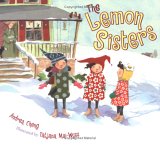
THE LEMON SISTERS (PICTURE BOOK)

PICTURE BOOK
THE LEMON SISTERS by Andrea Cheng, illustrated by Tatjana Mai-Wyss (Putnam)

In Chicago right now, we are in a deep freeze with windchills of 15 below, but hey, we're not complaining! We have our books to keep us warm!

In the spirit of "when life gives you lemons, make lemonade," (what a lovely, summery thought!) we have this delightful intergenerational story of an elderly woman whose memories of childhood come flooding back while watching through her window at three sisters ("Red Hat, Blue Hat and Yellow Hat") making snow angels. Little does our nostalgic onlooker know, brrrr-thday surprises are being planned in her honor, both by her new young friends and by her more wizened contemporaries, complete with snow thrones and lemon ice (a simple rebus recipe is on the endpapers). Full of busy action and thoughtful detail, brightly colored patterns in subtle multimedia collage give each picture an unusual texture, expressive depth and cheerfulness; it's a stand-out style deserving of closer inspection, and offers a pleasure that weathers repeated readings. This story is an example of a satisfying picture book that achieves what it sets out to do, perfectly capturing both the cold and the warmth of a fun, freezing day. You'll want sisters and friends like the ones in this book! (5 and up)
Also of interest:
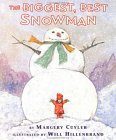
THE BIGGEST, BEST SNOWMAN by Margery Cuyler, illustrated by Will Hillenbrand (Scholastic) Big Mama, Big Sarah and Big Nell are less than supportive when it comes to including little Nell, but she shows them all when she and her animal friends are able to pull together a snowman that requires a double-page spread. Little children will be fortified by the "you can do it!" message, and the spirit of cooperation grows and grows with the rolling of every snowball. (4 and up)

Links are provided for informational use. Don't forget to support your local bookseller.

LinkWithin

Related Posts with Thumbnails