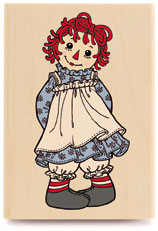
 Johnny Gruelle, the creator of Raggedy Ann, created a criteria for his own writing:
"It is the Gruelle ideal that books for children should contain nothing to cause fright, suggest fear, glorify mischief, excuse malice or condone cruelty."
While I am not personally in complete agreement with his perameters (it excludes fairy tales which may cause fright but still speak to a very visceral part of childhood), Gruelle's "ideal" often enters my mind as I am considering a book for review, especially because of the interesting concept of the "book for children." What makes such a book?
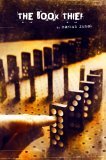
 Recently I have come across some books that I have greatly enjoyed or admired, but led me to wonder, why is this a children's book? I don't mean it as an accusation, but a real matter of inquiry. Books come to mind likeTHE POET SLAVE OF CUBA by Margarita Engle (Henry Holt), THE HOUSE OF THE SCORPION by Nancy Farmer (Atheneum), TIBET THROUGH THE RED BOX by Peter Sis (Farrar Straus and Giroux), A WREATH FOR EMMETT TILL by Marilyn Nelson (Houghton Mifflin), and my recent favorite, THE BOOK THIEF by Markus Zusak (Knopf). All of these titles are highly decorated with praise and even awards, and contain the kind of literary ingenuity and fearless content that take a reader's breath away and create new plateaus for writerly aspirations. These are the kind of books that make us feel smart for reading, for recognizing their value, for interpreting allusions and applying background knowledge and accomplishing all the cognitive acrobatics that are required to approach a real comprehension of what the artist is attempting. And yet, I can't help wondering, why are these considered and marketed as books for young people as opposed to just works of literature? The content and themes are so sophisticated. Where, in the process of creating these books, did the author or marketing department or buyers decide that the best audience for their content would be thirteen years old? Or is it all a moot point, as Dostoyevski probably didn't intend for Crime and Punishment to be assigned reading for American high school students, let alone less receptive eighth graders?
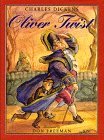 I am trying to recall my own encounters with literature intended for adults as a child, and the impressions that they left. I know my mother read aloud to me stirring short fiction from Grace Paley's ENORMOUS CHANGES AT THE LAST MINUTE (Farrar Straus and Giroux) and her favorite articles from the New Yorker when I was a pre-teen, and I remember very clearly understanding that 1) New York was the center of the universe of all things sophisticated and elegant, and Chicago, where I lived, was only a crater-filled hard-working little moon that rotated admiringly, almost jealously, around it (an impression marred only slightly by the later discovery that New Yorkers put garbage out on their front sidewalks and are notably impatient in restaurants); 2) This grown-up reading was an "in," and if I paid attention very carefully, I could learn a little bit about the way that the world of grown-ups works. When my father shared THE ADVENTURES OF HUCKLEBERRY FINN and OLIVER TWIST and even when I took the long independent march through Arthur Miller's THE CRUCIBLE (which I only abided because I gathered that it was something about witches), whether or not these books were intended for me was not nearly as pressing an issue as what would happen next; after all, these not being "children's books," I knew no one had invented an obligatory happy ending on my account. Things could really go either way. How exciting!
 And yet, for all the thrill of books intended for adults, for all the universal themes and unpredictable endings, they did not speak to me the way that the book about the boy traveling in the peach did. Or that girl who threw a shoe at the dog, and then had to make a replacement with paper and tape. Or the badger who foolishly traded away her hopes of a real china tea set. Or the family struggling with what to do about the crocodile in their bathtub. These books were meant for me, the way my parent's books were for them; they had authors who had me in mind, who were trying to imagine what I would like. Authors were kind, distant, faceless aunts and uncles trying to deliver to me the perfect gifts through their words and pictures: the promise that anything was possible, the friends I wished I had, the idea that problems could be solved by kids like me. These authors knew me well enough to know that pages of decription and a book without a laugh would not be tolerated, that things must Happen, and that I could smell a lesson as I could smell four-day-old fish, and likewise, would wrinkle my nose at it. I guess for me, one of the first thing I noticed about a true children's book was in the pacing; an author for children does not dare to expect that he or she will be indulged in any Proustian blather or pretention. For me, a true children's book needs to be honest and clear, and by honest, it should be funny in parts, because something that is never funny from start to finish is a lie.
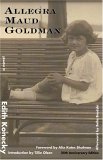
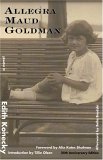 But on the shelves bowed with books waiting to be bought, what makes a children's book is sometimes not honest or clear. The blurry line between children's books and art books or just plain literature or just plain cr*@! is partly market driven. Would A Wreath for Emmett Till have found its readership had it been published in the adult poetry section? Would Tibet Through the Red Box have won awards as a coffee table book? Conversely, would a book like ALLEGRA MAUD GOLDMAN by Edith Konecky (Feminist Press), published twenty-five years ago, be marketed as a young adult (YA) novel today (and would it have a pink cover)? For that matter, would Huckleberry Finn be YA? Is it?
 Another fuzz-factor seems to be our own modern propensity to insist that the context in which children read is often as a means of assessment: grades, reports, standardized tests, Accelerated Reader points. Hence, children are encouraged to move swiftly out of "baby" books. I think that when I was growing up, it was perfectly respectable for a child of seven to be seen reading a picture book; now, children seem acutely aware of what other their peers are reading, books are leveled and there is a drive to read "up." This is why it's very important to read a book before you share it with a child. Children may have the ability to decode the content of a book, but the themes and content in that same book may not be developmentally appropriate for that child to interpret independently. Additionally, this trend explains a precipitous division between picture books and chapter books, with less market support for strong, text-driven illustrated stories in between. Translation: What will become of the next William Steig?
Lastly, another factor to consider as to why its becoming increasingly hard to tell what books are really meant for children is that there is so much media available through television and the internet and other sources, and frankly, not that much attention is paid to such divisions...kids are already exposed to so much. Because of historical associations literature has to intellectual pursuits and education in general, books are often treated tomore stringent standards than other media. (I gotta love when a parent who has cable in the house complains noisily of a little sexual content or strong language on the page. Ha! Ha! Ha! Hypocrisy is always funny, in that moment right before it is sad.) Frankly, what bothers me more than the standard Puritanical to-don't list is the marked increase I've noticed of books with charming covers and dear illustrations that take a flippant tone when it comes to the way children speak to one another. Name-calling and put-downs are particularly rampant in books aimed at readers 7-11. Children, of course, really do call names, but the laws of physics should apply: for every action there is an equal and opposite reaction, and for every blow, there should be some pain, if we learned anything from Eleanor Estes' timeless novella THE HUNDRED DRESSES (Harcourt)and from our own time spent on the playground. Certainly, pushing the envelope in terms of the way we treat others and the words we use and the number of times we use "poop" or underwear" are par for the childhood course, and, in fact, references to things that really make kids laugh or reflect the darker side of childhood can be considered groundbreaking in literature. But only when they are, in fact, groundbreaking. After a while, at best, it comes off as a little ingratiating. At worst, young readers are just plain manipulated into staring this mirror that reflects only the worst side of themselves, tittilated by the sheer recognition of something familiar or something taboo. Children's lit meets Madison Avenue.
I'm saying that as consumers,when we try to apply a modern "ideal" to what makes a children's book, these points are things which we ought to be aware. The world of children's literature is competitive, and inventive in its marketing; it's a shame that we can't always judge a book by its cover, because there are so many darn appealing covers out there. But as we work in the service of creating a new generation of readers, in whatever capacity that is, I think it is imperative that we differentiate excellence in books for children from books that impress adults; they are not always the same. I almost wish there was another genre within children's literature, the children's "art book," so that we could reward and celebrate the beauty of illustrated books and encourage bold experimentation by authors without dismissing others as facile, when really, they are speaking directly and genuinely to their intended audience. These quieter books, books that often don't receive the same media attention and sometimes require a bit of a hunt, are worth it.
But hey, enough musing-slash-ranting (unless, of course, you'd like to share your own thoughts in the comments section)! It's time for Book-a-Day, and it seems apropos to suggest a title that is really and truly written with a young audience in mind. I'm going to recommend it although it came out last year, because for some annoying reason it doesn't seem to be in every single collection yet. It's one of my favorite presents to give, and teachers, take note: I think this is the best fantasy read-aloud since Ruth Stiles Gannett's MY FATHER'S DRAGON.
 FICTION
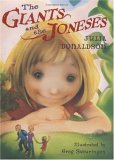
THE GIANTS AND THE JONESES by Julia Donaldson, illustrated by Greg Swearingen (Henry Holt)
Jumbeelia and Colette have a lot in common: they are both avid collectors, and they both tire of their collections fairly quickly. The big difference between them is just that: Jumbeelia is a giant, and she has finally found a magic bimplestock to climb down and collect some adorable igglyplops, or human beings…namely, Colette and her siblings! In this time of crisis the brother and sisters slowly begin to cooperate, but will it be in time to escape the dangerous clutches of callous brother Zab, the sharp claws of the spratchkin, or Jumbeelia's thoughtless neglect? Language arts teachers can luxuriate in the linguistic learning opportunities that this charming tale affords; invented Groilish vocabulary abounds and is the most fun since Lewis Carroll's Jabberwocky. With the help of a glossary, children will soon be bilingual in Giantese, and read-aloud has never felt so fresh and funny. Full of page-turning suspense, interesting problem-solving, themes of empathy and responsibility and distended spot illustrations that deliver us even further into fantasy, this reverse Jack and the Beanstalk has the makings of a classic in its own right. (7 and up)

 PICTURE BOOK/NONFICTION
 Look at this guy! Clearly, he knows what kids like.